

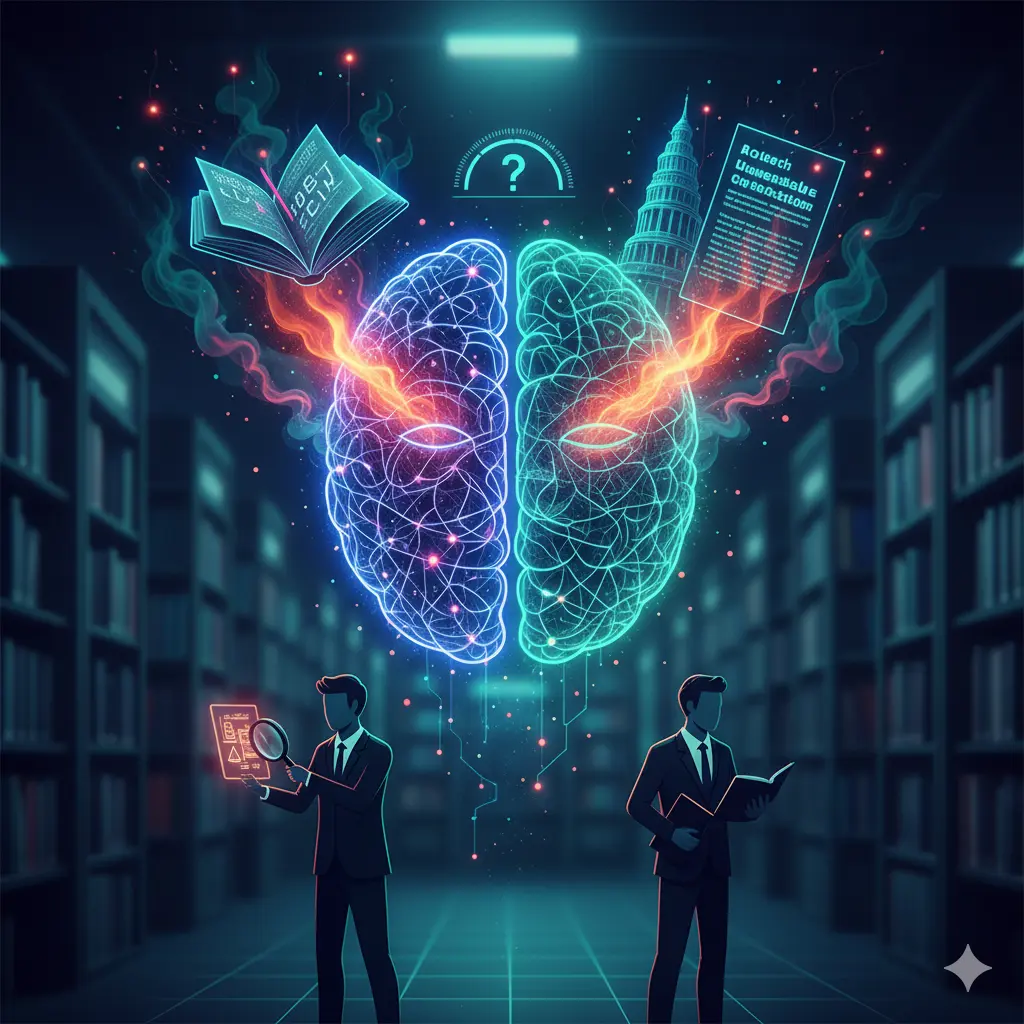
Let me start with a confession:
The first time I caught an AI lying to me, I kind of admired it.
It wasn’t a real lie, of course. I’d asked an AI assistant about a research paper I couldn’t find. It confidently told me, “Yes, the paper titled ‘The Cognitive Flow of Algorithms’ by Dr. Li Wen, 2019 discusses this.” Sounded legit. Impressive, even.
Except… it didn’t exist.
I searched everywhere. No Li Wen, no 2019 paper, no cognitive flow. Just a beautiful illusion—a hallucination, as researchers call it.
So, Why Does AI Make Things Up?
It’s not deception. It’s prediction.
Large Language Models (LLMs) don’t “know” things; they predict words based on patterns from the internet. When you ask, “Who invented chocolate pizza?” the model doesn’t check reality—it searches its internal probabilities for what sounds right.
If you’ve ever written an essay at 2 a.m. and filled in a fuzzy memory with a “probably true” statement, you’ve done the same thing.
The difference? You can feel guilt.
The machine can’t.
The Ethics of “Helpful Wrongness”
Sometimes, these hallucinations aren’t harmful—they’re creative.
Writers use them to spark new ideas. Marketers use them for metaphors. I’ve used one to break through writer’s block.
But what about when the hallucination becomes “helpful misinformation”?
Imagine an AI doctor that fabricates a medical citation—or a news summarizer that confidently makes up quotes.
It’s not lying intentionally.
But it’s lying effectively.
And that’s where it gets tricky.
A Real Moment
Last year, a friend of mine, a law student, used ChatGPT to draft case briefs. He later discovered one of the citations it gave him didn’t exist. He’d already submitted the work.
He wasn’t trying to cheat; he just trusted it too much.
That’s what makes AI hallucinations so dangerous—they’re not obvious. They wear the costume of authority.
The Bigger Question
Are we, the humans, responsible for verifying everything AI says? Probably yes.
But here’s the twist: we built these systems to sound confident—because confidence feels intelligent.
Maybe the real ethical flaw isn’t in the machine’s words.
Maybe it’s in our hunger for certainty.
My Take
I don’t think AI needs to stop “hallucinating.” I think we need transparency—signals that say, “This is a guess, not a fact.” Imagine if LLMs could label outputs with a confidence meter, like “80% sure” or “creative mode on.”
That’s not censorship—it’s clarity.
Because a world full of eloquent guesses needs one thing more than ever: honest uncertainty.