
Ever had a chatbot reply to you with something so off that you had to laugh out loud? I once asked a customer service bot, “Can I return this shirt if it doesn’t fit?” and it answered, “Thank you for your interest in our socks.” Socks. I hadn’t even mentioned socks.
And that’s the funny, frustrating, and fascinating part about how NLP (Natural Language Processing) and LLMs (Large Language Models) work together.
NLP: The Rules of the Game
Think of NLP as the grammar police. It sets the structure, the parsing, the understanding of intent. Without NLP, machines would choke on the way we jumble language: slang, emojis, run-on sentences, sarcasm.
I remember building a basic chatbot for a workshop back in 2017. I thought I was clever—I gave it a small dictionary of phrases so it could answer things like “When do you close?” But people asked stuff like, “Hey, what time do you kick us out?” The bot had no clue. That’s NLP’s job: to map human messiness into structured meaning.
LLMs: The Flow and the Feel
Now, LLMs bring the style. They don’t just understand a phrase—they generate responses that sound natural, fluid, sometimes even witty.
Take ChatGPT or any similar model. Ask it, “What’s your favorite movie?” and even though it doesn’t watch movies, it’ll reply with something charming like, “I don’t really watch movies, but I’ve heard Inception is a mind-bender.” That’s fluency. That’s the human touch.
I’ve used LLMs to draft blog intros (like this one, ironically). And while I always rewrite in my own voice, there’s something about the rhythm of their language that helps unstick my brain.
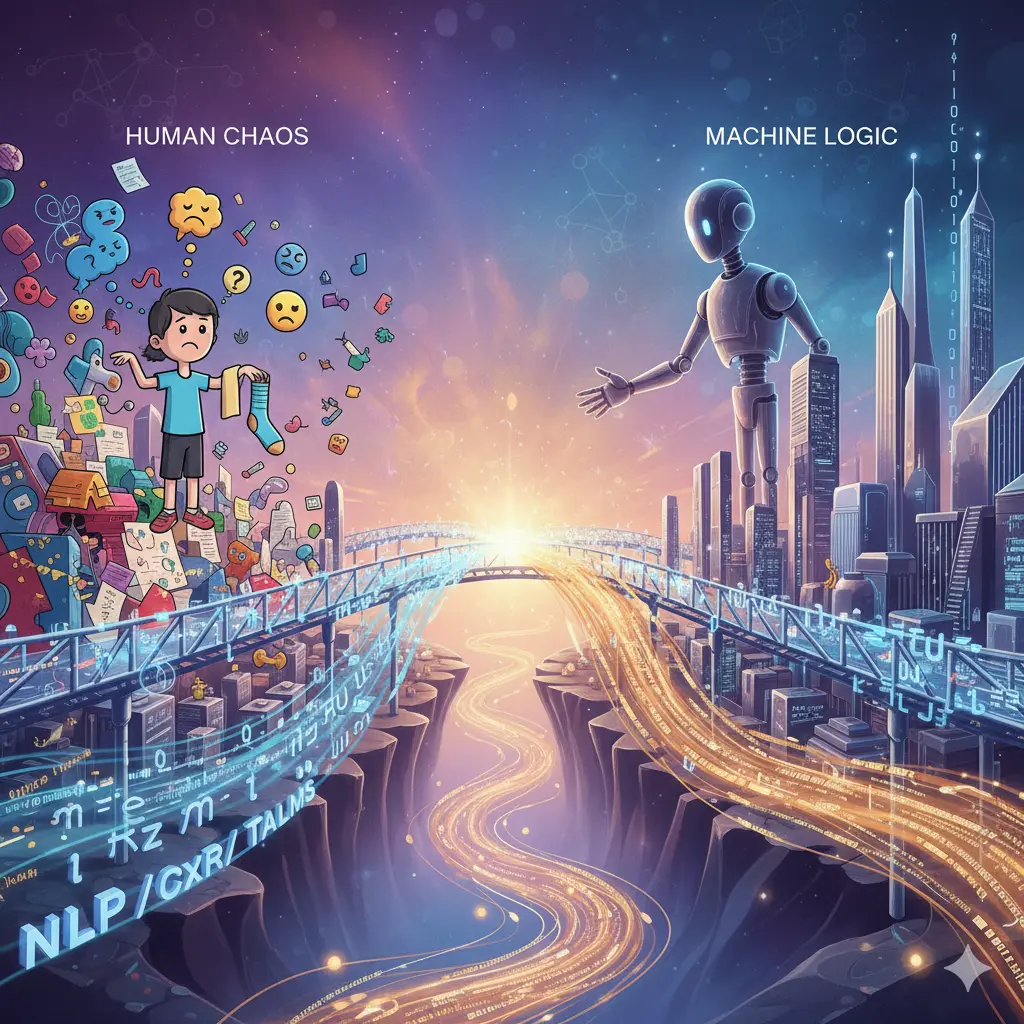
The Magic is in the Bridge
Here’s where it gets exciting: when NLP and LLMs work together. NLP handles the messy input—understanding that “book cave” means “library” or that “kick us out” means “closing hours.” Then the LLM takes over, delivering a reply that doesn’t sound robotic.
It’s like NLP is the translator, and LLM is the storyteller.
But here’s the truth: it’s not perfect. And maybe it shouldn’t be.
Why the Imperfections Matter
The awkward moments remind us these systems aren’t human. I actually find comfort in that. Once, while helping my cousin prep for a college application essay, he asked the AI to “make it sound inspiring.” The draft came back with lines like: “The sun rises not only in the sky but also in the heart of those who dare to dream.”
We laughed so hard. It was cheesy, but it also gave him a spark. He rewrote it into something authentic, his own.
The beauty wasn’t in the polished perfection. It was in the misfire that pushed him to write better.
The Road Ahead
Will the combo of NLP + LLMs ever be flawless? Probably not. Language isn’t flawless. Humans contradict ourselves, switch tones mid-sentence, add inside jokes only two people on Earth get.
What machines are doing is learning to dance with that chaos. Sometimes they step on our toes, sometimes they surprise us with moves we didn’t expect.
I think the goal isn’t to make AI sound exactly human—it’s to make it useful, supportive, and a little bit fun. The mistakes, the awkward chatbot moments, even the overly dramatic “sunrise in the heart” lines—they remind us that language is deeply human. Machines are just guests at our table, learning how to join the conversation.
So next time an AI says something silly? Smile. That’s the bridge in action—messy, imperfect, but kind of beautiful.