
It’s strange to think how far we’ve come since Understanding Large Language Models (LLMs): A Beginner’s Guide.
Back then, we were just trying to understand what LLMs even are. Then came the parts about how they’re used, how they learn, and what happens when people and machines try to work together.
Now, standing at the end of this series, one thing feels clearer than ever — this story has never been only about technology. It’s about us.
Where It All Connects
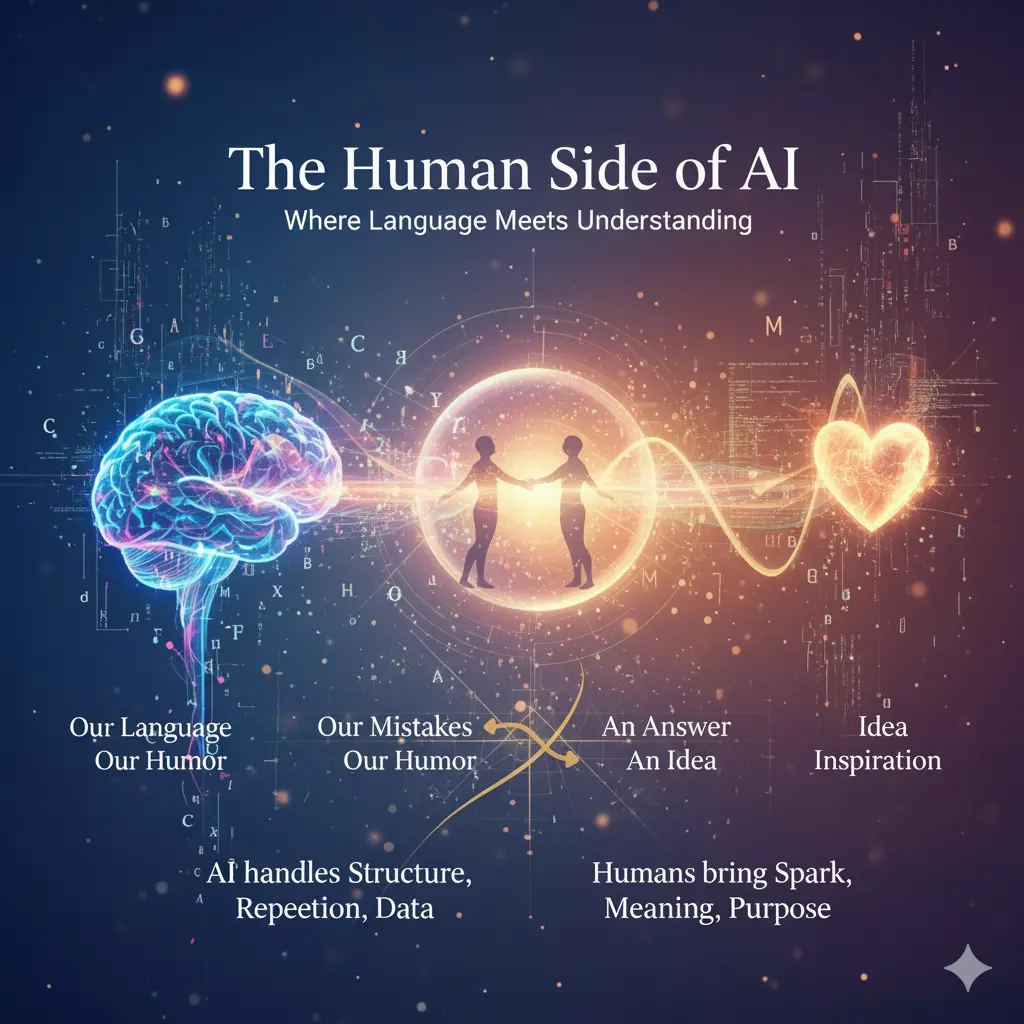
Every large language model starts with human input — our language, our mistakes, our humor, our bias.
AI isn’t born knowing anything. It learns from what we leave behind.
When we say “it understands,” we’re really saying it recognizes something we once wrote or thought. And somehow, through those millions of words, it gives something back — an answer, an idea, sometimes even inspiration.
That back-and-forth is what fascinates me most. It’s not perfect, but neither are we.
Power Doesn’t Mean Purpose
We’ve seen through earlier parts how powerful these systems can be — how they can write essays, debug code, or summarize a whole book in seconds.
But that’s not the part that matters most.
What matters is why we’re building them.
Because power without direction doesn’t do much good.
The question isn’t “Can AI do this?” anymore.
It’s “Should it?”
And more importantly, “How do we make sure it helps someone?”
Working Together
In Building a New Partnership Between People and Technology, we talked about partnership — humans and machines building things side by side. I still believe that’s the most exciting part of this whole evolution.
AI can handle the heavy lifting, the repetition, the structure.
We, on the other hand, bring the spark — the parts that make ideas actually mean something.
That mix feels right. It’s not about replacing people; it’s about giving us room to do more of what only humans can do.
A Quiet Reminder
It’s easy to forget that all this technology is still built around language — one of the oldest human inventions.
Every time you ask an AI a question, you’re really continuing that same old tradition: trying to communicate, trying to understand.
So maybe the goal isn’t to make machines perfectly human.
Maybe it’s to remind us to stay human while we build them.
Final Note
Large Language Models have already changed how we work, write, and learn. But they still depend on us for direction, meaning, and purpose.
If this whole series had one message, it would probably be this:
AI doesn’t replace human intelligence — it reflects it.
The real future of AI isn’t about machines learning to speak.
It’s about how we choose to listen, teach, and keep humanity in every line of code we write.