
In the last part, we covered the basics of Large Language Models (LLMs)—what they are and how they manage to “talk” like us. Now let’s shift gears. Instead of theory, let’s look at how LLMs are actually showing up in everyday life. And, if you’re curious, we’ll also take a tiny peek at the advanced stuff happening behind the scenes.
🌍 Where LLMs Are Making a Difference
These models aren’t just living in research papers anymore—they’re out in the wild, doing real work:
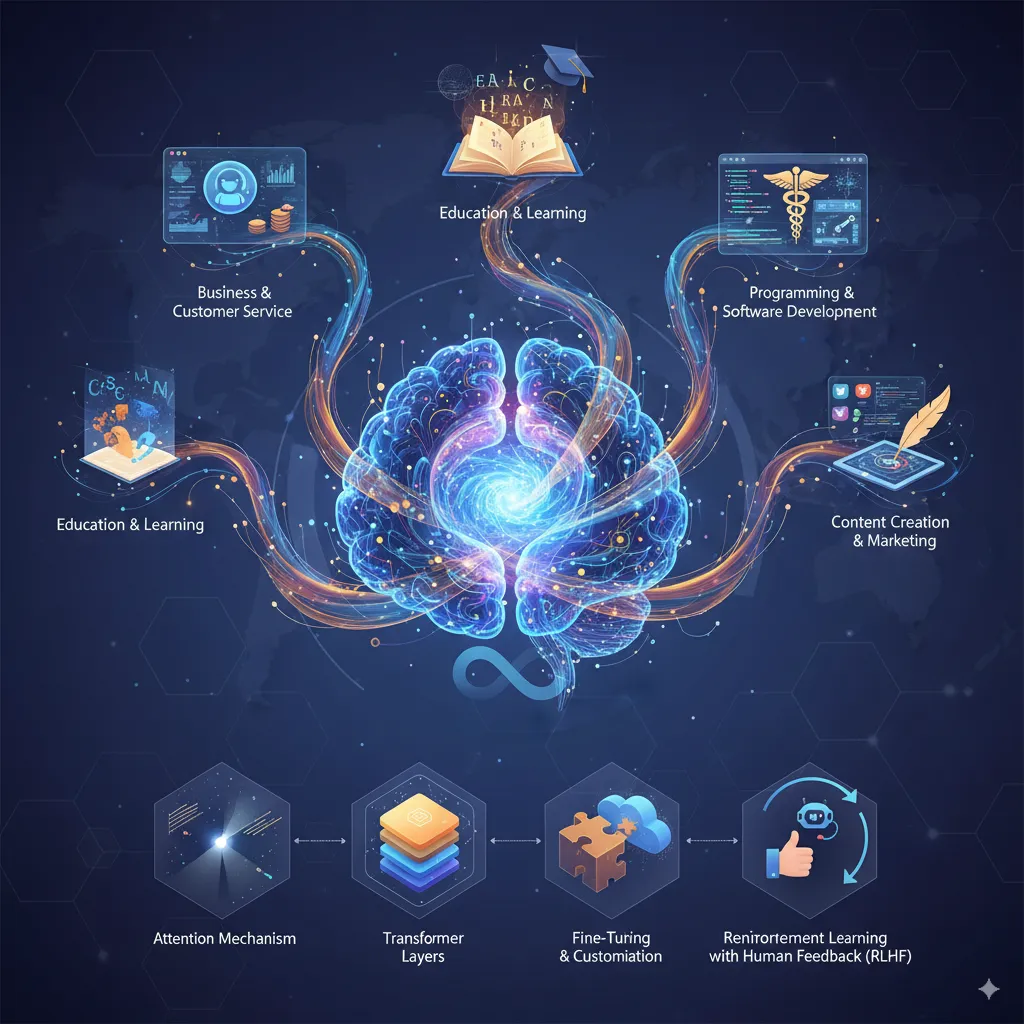
1. Business & Customer Service
Ever typed a question into a company’s chat box at midnight and got an instant reply? Chances are, that’s an LLM at work. Beyond chatting, they’re helping teams write reports, scan through customer reviews, and even highlight trends businesses might miss.
2. Education & Learning
Imagine a tutor who doesn’t roll their eyes when you ask the same question five times. That’s the vibe LLMs bring. They can simplify textbook chapters, generate quizzes, or explain concepts in everyday language. Students and self-learners are finding them super handy.
3. Programming & Development
Developers have a soft spot for these models. Why? Because they can suggest code snippets, spot silly errors, or even write documentation (which, let’s be honest, nobody enjoys doing). It’s like coding with a very patient partner.
4. Content & Marketing
Writer’s block? Marketers and content creators use LLMs to spark ideas, draft social captions, or even spin up whole blog outlines. It’s not about replacing creativity—it’s about jump-starting it.
5. Healthcare & Research
This one’s big. Doctors and researchers are leaning on LLMs to summarize long studies, draft patient notes, or quickly pull out the key points from clinical guidelines. Of course, humans make the final calls—but it takes a huge load off their plates.
🚀 A Tiny Peek at the Advanced Side
Okay, so if you’re curious about how the magic works under the hood, here’s a taste (without frying your brain with math):
-
Attention Mechanism → This is what lets the model “focus” on the right part of a sentence. Like when you say, “The dog chased the cat, and it ran away.” The model needs to figure out that “it” means the dog.
-
Transformer Layers → Picture language being peeled layer by layer, each one adding more detail until the model fully gets the meaning.
-
Fine-Tuning → Businesses can take a general model and train it on their own data. So instead of just chatting, it might specialize in reading contracts or writing medical summaries.
-
RLHF (Reinforcement Learning with Human Feedback) → Basically, this is how humans guide models to be more helpful, safe, and aligned with what we actually want from them.
✨ Wrapping It Up
LLMs are already woven into our lives, from helping doctors save time to making writers’ jobs easier. And honestly, we’re just scratching the surface.
If you’re just curious, the basics are enough to understand why they matter. But if you want to dive deeper, the advanced side—transformers, attention, fine-tuning—is where the real fun begins. That’s where you start seeing how these models are trained and how people are customizing them for specific industries.
Stick around, because in the next deep dive we’ll roll up our sleeves and talk about how transformers really work—and what it takes to train or tweak one for your own use.
💡 And hey, if you happen to be working on a Laravel project—whether you need to upgrade it or build something brand new—our team at BrainsOfTech can help. We combine hands-on experience with the latest tools to make sure your project isn’t just done, but done right.